Saturday, March 30, 2013

Little Jerusalem Pitigliano Italy


Cari Amici (Dear Friends),

I found myself exploring the town of Pitigliano, Italy, recently thanks to my friend Caroline. Pitigliano lies south and east of the more famous Grosseto and is very close to the southern Tuscan border. Pitigliano has a history dating back to the Etruscan times, but in 1293 the Orsini family gained control and began its history warring with Siena.

The city emerges above the tufa rock, rising from organic to geometrical forms, with caves visible in which I was told that hermits used to occupy. Those spaces closer to the paved road that leads into the city were once used to keep donkeys. Now they are simply storage rooms.

I thought it was funny that the map of this city perched on an elongated peak looks a bit like a slug from above, since my traveling companion and tour guide described this city as beautiful, but a bit claustrophobic. She said she could not life there because of the closeness of everything, namely the narrow streets. I knew that I wanted to come back to explore this place longer than the two hours or so that we had there.

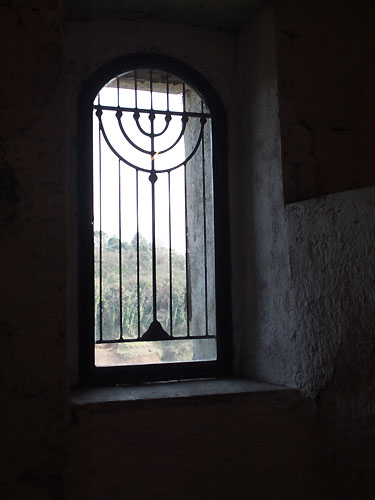
While there are few if any Jewish people living in Pitigliano today, it was historically a town quite friendly to the Jewish population. My friend Caroline and I visited the former ghetto in the historic district, now a small museum. We learned that in 1556, a Jewish cemetery was created by the nobleman Niccolò Orsini IV, who had always been supportive of the Jewish population in his territory. He gave the land for this purpose to his personal physician, David de Pomis, a Jew. You may see this cemetery in the last image of this post, below the cypress trees on the left and above the bridge of arches.

The Ghetto was officially begun in 1622 by the ruling Medici family. In the 1800s one-fourth of the population of Pitigliano was Jewish and the community became known as “Little Jerusalem” (a name given by the Jews in Livorno, a city to the north). The brochure says that after the Unification of Italy in 1861 and the emancipation of the Jews, many Jewish people left Pitigliano for larger cities. It is also reported that the remaining Jews were helped out of the city by their supportive neighbors as the racial laws and dangers of World War II came about. Today the city is reported to have so few Jews that they cannot gather enough for a minyan, the minimum number of ten adults required for specific religious gatherings.

The thick stone walls of “Little Jerusalem” give one the impression of being in a cave. In truth, the Jewish people simply adapted the existing spaces when they settled in this part of Pitigliano. And people for centuries have understood the value of going underground for consistently cooler temperatures to store wine and other goods. A couple of the upper rooms near the entrance housed Jewish items, many of which I found quite beautiful, such as this woven Havdalla Candle for use on a Saturday evening. I also found the scroll and the Hebrew writing lovely.

The image of the room with the black bars in front of it is the butcher’s area. It was here that animals were slaughtered in accordance with the Jewish laws. After death, the blood is drained from the animals so that the people will not consume it since “blood is life.” [I do not quite understand this idea (do we not eat to live?), but then it may be that the brochure has simplified a lot and I did not intend to do an in-depth study of cultural rites, however interesting.]

The Synagogue of Pitigliano was built in 1598, but collapsed gradually in the 1960s. It was restored in 1995 and contains furnishings from the 17th and 18th centuries. One cannot enter the prayer room; however we followed the stairs to a balcony. A beautiful wooden rail in a lace-like pattern protected us from falling. It was quite high, but I did manage to stick my arm out above the top rail to show you the downstairs, as well as the ceiling.

You might wonder why I am writing about ruins and such when this blog is usually about art. In my mind, everything is connected. And as my late friend Vasily Fedorouk liked to say, “The artist is the best kind of scientist because he studies everything.” I think the word “best” is something lost in translation for my Ukrainian-born friend, but I think you can grasp his sentiment for artists.

Sunday, March 17, 2013

Still Life Tenebrous Painting


Cari Amici (Dear Friends),

Here is a sneak peak at my current project in a Tenebrous still-life painting (Tenebrism). One of the objectives in this project is to create a painting that has text in it. One wants an idea of the quality of the text, but not necessarily be able to read it. I think it is better if one cannot read it since I usually find words in art distracting from the visual experience. While this is still a work-in-progress (WIP), you can already (I hope) get an idea of what is printed material vs. what is handwriting.

I must apologize for the quality of the images taken during this project. There is so much glare in this studio here in Italy that it makes it more difficult than usual to photograph an oil painting. The colors that I am painting are richer that what you see here.

Now, on the other side of that Atlantic Ocean, I will be teaching a Portrait Painting Workshop in central Florida. I will focus on how to create a likeness and go for a three-dimensional look. You will see some of the techniques and concepts that I have learned over the many years of creating, from sculpture to painting to street painting! The dates are May 17-19, 2013, and there is an EARLY BIRD REGISTRATION low price of $220 if you register by the first of April. [After 1 April 2013, the price is $290 for the 14-hour weekend workshop.] To learn more, please visit: www.borsheimarts.com/art-workshops/2013ArtPortraitWorkshopFlorida.htm Thank you for your interest!

I hope you will be a-wearin’ o’ the green today! Share the Irish love.

St. Patrick’s Day, Irish, art workshop, portrait workshop, tenebrous, still life painting

Monday, March 11, 2013

Basilica di Santo Spirito Florence Italy


Cari Amici (Dear Friends),

One of the most interesting and certainly lively squares in Florence, Italy, is Piazza Santo Spirito. She thrives on the Oltrarno “other side” of the Arno River from Florence’s famous Duomo (in the background right of my first image). There is a market every morning and a different one all day on Sundays. I ended up randomly meeting several friends here recently as we shopped all of the eye candy and also bought some local organically grown foods (a bit of a redundant phrase for these parts).

The Basilica di Santo Spirito is a distinctive church that resides on the end of the piazza that is closest to the River Arno. It is not often that it is open to visitors, but today I wanted to share some of the art and architecture of the inside of this amazing place. Of special note is that two of the first sculptures that you will see (one on each side of the doors) are very good copies of Michelangelo’s compositions, the “PietĂ ” and “St. John the Baptist.” I believe the artist was Giovanni Lippi, an architect who worked under the name Nanni di Baccio Bigio (1510-1568) and a contemporary of the great Michelangelo. I hope you get the chance to visit the Basilica di Santo Spirito and the piazza with the same name. So much art is INSIDE the churches in Italy!

Now, on the other side of that Atlantic Ocean, I will be teaching a Portrait Painting Workshop in central Florida. I will focus on how to create a likeness and go for a three-dimensional look. You will see some of the techniques and concepts that I have learned over the many years of creating, from sculpture to painting to street painting! The dates are May 17-19, 2013, and there is an EARLY BIRD REGISTRATION low price of $220 if you register by the first of April. [After 1 April 2013, the price is $290 for the 14-hour weekend workshop.] To learn more, please visit: www.borsheimarts.com/art-workshops/2013ArtPortraitWorkshopFlorida.htm Thank you for your interest!

Sunday, February 24, 2013

Portrait Workshop Florida


Cari Amici (Dear Friends),

Well, newsflash! I have just firmed up a workshop that I will be teaching in central Florida this May. I hope you may join me and let us make some art!

"Portrait Painting with Artist Kelly Borsheim"

2013 Art Workshop Dates:
Friday, May 17 from 6-9 pm;
Saturday, May 18, 10 a.m. to 5 p.m. (lunch is from 1 to 2 p.m.) and
Sunday, May 19 from noon to 5 p.m., 2013
(14 hours in total)

Location: Private historic Victorian estate in Sanford, Florida (central Florida). Paid attendees will be given the address before the workshop begins, but the location is near Country Club Road on Highway 46A.

In this hands-on introductory weekend portrait workshop, you will learn how to improve your drawing and observation skills for creating a portrait and how to achieve a more 3-dimensional effect in your art using pastels and charcoal. Or you may prefer to work with oil paint.

Instructor Kelly Borsheim will demonstrate for the class, as well as assist students on an individual basis on their project(s). Emphasis will be on the designing of a portrait and not so much making something look photographic. For this reason, we will create a copy of a master artwork (please choose one shown on the information page on Kelly’s site, borsheimarts.com. On the last day, if you like, you may bring in a photograph of a person's face and we can work with designing a portrait from it. [Or you may bring in a current project you wish to improve.] If you would like to do this, please contact the instructor for more information on the kinds of images you will need to take of your subject.

This workshop is intended for beginners, intermediate, and any professional artists who would like to work on design and technique for portrait painting. However, many of the concepts demonstrated and discussed will apply to many subjects in art. You will receive much personal instruction in a peaceful environment.

Participants do not need to have had prior art experience, although some drawing skills will be helpful. Class size is limited, so please enroll early. More details, as well as the supply list and prices, are listed on the information page on Kelly’s site, borsheimarts.com.

Thank you and by all means contact the studio with any questions!

The above portraits you see here are ones that I created. This last image is a portrait by Pietro Annigoni and is one of the choices you will have to copy in this workshop. Annigoni was a very good designer of portraits!

Sunday, February 17, 2013

Carrara Marble Pietrasanta Sculpture


Cari Amici (Dear Friends),

Well, what a surprise to learn that this is my 600th blog post! Who knew that I had it in me? So, I am happy that what I wanted to write about was my recent trip to Carrara and Pietrasanta, Italy. Marble is my drug of choice and I miss carving it very much. However, like my dream to have a dog, some things will have to wait until their time comes again.

My friend and fellow sculptor Gilbert Barrera came to Italy from San Antonio, Texas. We met each other MANY years ago when he came to Austin, specifically the Elisabet Ney Sculpture Conservatory, and met our group up there. Like me, Gilbert came to Italy to improve his art skills. This first image is of the two of us standing next to his current project in Carrara, Italy. He wants to carve this marble all with hand tools… good enough for Michelangelo, afterall. I am too impatient for that sort of thing, but respect that we all have different goals in life. At least Gilbert is doing SOMETHING with stone now!

We then headed to Pietrasanta for some lunch and sculpture viewing. “Convenient” is rarely a word one thinks of when Italia comes to mind. With the poorly timed train schedules to these industrial towns, one usually finds oneself here during the long lunch hour and things are mostly closed. However, il Museo dei Bozzetti was open. Housed inside of the library, the museum is where they keep a decent collection of plaster sculptures that were used as the models for artists to copy their works into marble. Direct carving is not as well known as in the States.

My favorite works here are those of Leone Tommasi, sculptor active around 1930s and 1940s. His realism in the human figures is like a caress in his sensitive forms. When Gilbert saw the reclining Jesus sculpture, he remarked that Tommasi understands well the form in gravity. Like Pietro Annigoni, Leoni Tommasi was creating a very different style of work from what was popular in his own time. I am glad his stuck to his guns. The next images you see here are all the works of Leone Tommasi.

After all of this, I had to show Gilbert the piece that completely surprised me during my first visit to Pietrasanta in 2004. Charles Umlauf was a sculptor who lived, worked, and taught in Austin, Texas. He even has his own museum there and the Umlauf Sculpture Garden & Museum is a real gem in the town! Naturally, I have spent time there and am familiar with his work. I was stunned to bump into his “Eve” so many years ago! Later, Nelie Plourde, director of the Umlauf Gardens, told me, as I related to Gilbert yesterday, that Charles Umlauf found it better and cheaper to create the art here in Pietrasanta, cast it into bronze here, and then SHIP it to the USA. Here we are posing (using my self-timer on the camera) with Umlauf’s “Eve.”

Finally, I leave you with a sculpture that amuses and charms me. It was sculpted by Giulio Ciniglia and is titled “L’ora” (The Time) from 1992. Ok, I have got to go. Just look at …

Thursday, February 14, 2013

Love and Courage


Cari Amici (Dear Friends),

"For a relationship to stay alive, love alone is not enough. Without imagination, love stales into sentiment, duty, boredom. Relationships fail not because we have stopped loving but because we first stopped imagining."
- psychologist James Hillman

"Love is the most difficult and dangerous form of courage. Courage is the most desperate, admirable, and noble kind of love."
- Delmore Schwartz

Happy birthday, Cayla!

Tuesday, February 12, 2013

Mermaid Bronze Sculpture


Cari Amici (Dear Friends),

I always loved the Grimm fairy tale of “The Little Mermaid.” Here was depicted a creature who had no soul (but wanted one), but knew what love really was. As a young girl, and even now I suppose, I am touched by the story of her figure falling in love with a human prince, saving his life when his ship capsized, and allowing another girl to take the credit and the joy.

As luck – and the nature of a good story – would have it, the Prince fell in love with the girl he thought saved his life. However, our heroine went through great personal costs (her lovely singing voice traded for a pair of legs to replace her tail, but sharp pains were felt whenever she walked or moved with those legs) and finally met her prince after she transformed on his beach. While he became enchanted by the youngest daughter of the Sea King and loved her in his way, she never gained his romantic love.

As his closest companion, she had to endure watching him marry another. On top of that, she loved him too much to refuse his asking her to dance for them all at the wedding, despite the physical pain the movements gave her. She had no voice with which to complain. The rules of her world dictated that as the sun came up the morning after her beloved had chosen another, her life would end and she would become sea foam, returning to the ocean, her natural life cycle cut way short.

During the night of the wedding, the little mermaid’s older sisters swam to the boat where the festivities were taking place. They, too, had been to see the Sea Witch. They traded their graces for a special knife. If the little mermaid were to use that knife during the night and kill her beloved and his new wife and let their blood run over her legs, she would have her natural life as a mermaid back and could return to her royal family.

The Little Mermaid stood in the dark bedroom of the slumbering newlyweds that night. Love completely overwhelmed her as she gazed down upon them. She could not harm them. She left them there and went to meet the sun. Her body became lighter and lighter. The sea was before her. But she felt herself lifting higher and higher. . . until she began to see small figures in the air beside her.

Because of the pure and unselfish love she had shown, she was being given a second chance to gain a soul. She had become a “Daughter of the Air.” Depending on the joys and sorrows of the children she was to witness, there was a faint possibility that over much time, she could gain a soul. It was not love, but a soul is something, isn’t it? And it is interesting that gaining a soul depended on the behaviours and whims (or love?) of others. Well, Grimm IS the name of the author, after all! Ha.

Sadly, from my point of view, the prince and his bride never understood what happened. They were oblivious to her pain. They never appreciated that in the hands of another, they could have died. They never knew how much she loved them. They never knew what happened to her. And worse, perhaps, they never knew that they could help her in her new search for a soul.

What I always liked about the ending is that idea that we do not know how our choices, our smiles, our groans, affect others. So, should we not do all we can to lighten the load instead of possibly denying one a soul or at least a chance at happiness? I have never seen the downside of a genuine smile.

Art Anniversary Promotion: Get more art for your buck. Hurry, this one-time offer expires on 15 February 2013.