Showing posts with label Vasily Fedorouk. Show all posts

Wednesday, August 9, 2017

Sculpting Wind


Dear Art Lover,
Kitchen as art studio bas-relief sculpture compressed form
Kitchen as Art Studio
     The last time I showed you a progress image on my new bas-relief sculpture project, “Wind and Wisteria,” was in my post on 18 June, when I was still in a cast for a broken right wrist.  I started the piece with my left hand.  The cast was removed on 30 June, and I have done a bit of work since then. 

     I asked my landlord and my neighbor to lift the big board into my kitchen just before we got a few days of decent [certainly better than nothing!] showers.  This is how far I had gotten with my non-dominant hand.  I wanted the piece more vertical so that I could start developing it.

     Bas-relief is not “puffy painting” as I once thought before meeting Eugene Daub and Vasily Fedorouk.  It is compressed form.  That is a HUGE difference.  What I mean by “puffy painting” is possibly similar to quilt making…where one defines the boundary of a shape and then puts stuffing inside of it.  It is a look, but it is not bas-relief sculpture.

Lighting is important when creating bas-relief sculpture compressed form
Side lighting from kitchen door

Lighting is important when creating bas-relief sculpture compressed form
Harsh top lighting, but you see the difference from above?
 
Male model young boy in bas-relief sculpture Borsheim Art
     So, I prefer to create a bas-relief sculpture with an overhead light that helps me to see where the material is in relation to other parts.  However, this green plastilina [an oil-based clay] does not seem to have enough oil in it to stick well to the wood board, and I woke one morning to see that the boy’s face and broken away from the composition and slid down.  Luckily it was not damaged much.  I have since developed the form more anyway.  [You may see in the close-up shape here that I still have work to do.  For example, the lips have to be refined.  There is too much harsh light outlining the lips.  I need to fill-in some placed with clay, soften shapes, and think of the form of the mouth barrel.  I hope to make the mouth more kind and youthful.]

     Clay absorbs much more light than metal does.  If something looks contrasty in the clay, it will be so much worse in reflective metal!

     Lately, I have been creating the individual petals of the wisteria.  It is past time for the real blooms on my gate, although I have a few random flowers that are confused by the watering and drought.  Trying to understand them as models, but I am also using images as references.  Mamma mia, what a lot of work!  I find myself intimidated wondering if I can create the airiness of wind blowing in dangling petals in a thin sculpture.  When I feel this way, I often force myself to work and accept that it will go slowly as I figure out how to do what I think I want.  And another part of the day, I start a new project, because starting is always fun, as one sees change and development move along quickly.  I have learned that this is the only way I can get through the hump of the tough times.

Starting to model wisteria in bas-relief sculpture Borsheim Art

Artist working in kitchen during hot summer on bas-relief sculpture in clay

Wind personified as woman in bas relief sculpture
      For the head of the wind, I am also struggling.  I am not sure that I am capturing the idea that she is blowing, ie that SHE is creating the wind, or she is the wind personified.  And I chose to make a composition that will be empty inside the shape, allowing the wall to show through once hung.  This means that I have fewer things around her to show the effects of wind.  Maybe not the smartest idea, compositionally speaking?  Piano, piano as they say too often in Italy, “slowly, slowly.”


Peace,


Kelly Borsheim, artist

P.S. Look at my cool phone case that I ordered for myself as a gift for moving into the modern age of smart phones.  You may find your own desired cover design, or other products here:
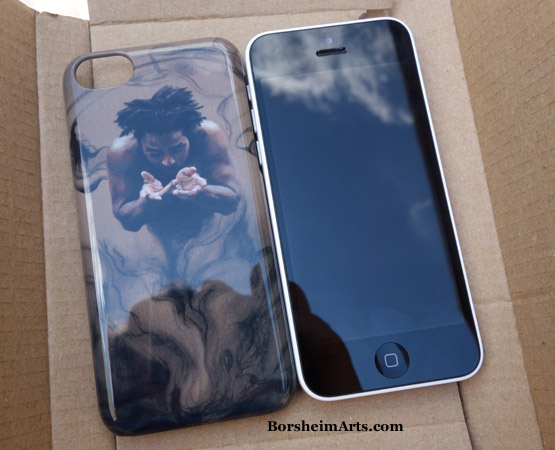
Il Dono - Borsheim Art on iPhone 5c case -choose yours


Sunday, December 21, 2014

Trieste Italy Fountain of the Tritons Sculpture Part 2 of 3


Dear Art-loving friend,

     While on a layover in Trieste, Italy, I found the Post Office on one side of a grande piazza.   As I mentioned in yesterday’s blog postabout the architecture of Trieste, the city looks more Austrian than Italian, at least in parts.  This is one of those parts.   

     Even though I knew that I would be waiting a long time inside the post office, I decided to get a good look at this beautiful sculpture of three figures holding up a shell in the well designed Piazza Vittorio Veneto.  La Fontana dei Tritoni (The Fountain of the Tritons) was not running, no doubt because of the colder season upon us, but still it is lovely.


     Two of the figures are male, the third is female and her legs EACH become tails [while theirs do not].  Did the artist make these choices for a reason other than varying composition?  Hmmm.. I could not tell you.  I tried to find information on the sculptor once I arrived to my new home in Umag, Croatia.  I found a name that could be the one inscribed in the stone:  Austrian sculptor Franz Schranz.  However, the dates given for this artist are (1747 - 1835) and say that he is a painter, not a sculptor.   While my photograph of the signed fountain makes it hard to read the artist name, the date seems much clearer to be:  1899.  I had found another blog or Web page in an image search for this fountain and that was how I came up with the Franz Schranz name in the first place.  That page said the fountain was DESIGNED by him.  Perhaps that is accurate and someone else executed the sculpture.  However, if he is listed as a painter and not both painter and sculptor, I think the search could continue. 


     How could anyone make such a large work and in relatively recent history and have no one know the artist?  Hahah… maybe that is a silly question.  But perhaps the City of Trieste knows more and we silly travel bloggers do not stay in town long enough to ask or follow-up.

     I enjoy the chiseled fine features in the face, as you see in the first close-up image posted here.  At first I thought it was sweet that two of the figures were holding hands, but upon closer inspection, they are not really.  He is holding onto her, while she holds onto the structure.  Is he just THAT muscular or is his arm tensing muscle as he uses force upon her arm?  Is he helping or hurting?  He looks way more relaxed in the front shot of him.  And in general, all of the figures look as if the artist had recently studied anatomy and wanted to show off his knowledge of each and every sinew.


    I remember very clearly, my friend and mentor Vasily Fedorouk saying, “When you learn to play the piano, you learn each and every note.  But when you make music, you do NOT play them all at once!”


     The other male Triton at first seemed a bit disconnected from the couple.  I thought that he was looking down, lost in his own thoughts while under the burden of his shared task.  However, look at my close-up shot of the Nereid (and her grapefruit breasts!).  She seems to be looking towards him, as if wondering if she is catching his attention!  Is she lifting her hair so that he can get a better glimpse at the goods?  And he… he appears to be looking her way, unable to get a full gander because of his position.  Are they flirting with one another?  Hahah.. well, why not?  Life is hard enough when you have a load on your back!  And if morality is the problem, well, they are probably destined to live the life as Tantalus did… any movement affects the whole and they are kept in place by their mutual task of holding up the shell fountain.

Thoughts without action can be torture!  


Enjoy the Solstice and this longest night of the year!
And in case you missed my recent art newsletter about Carrara and BLIND stone carvers, please click here:
Thank you.
++++
Blatant Promo:  Give art or at least an art book as a Christmas gift – more unusual and personal than many other choices.  Check out my site for options:  http://BorsheimArts.com

If you are enjoying this blog, the writing and/or the images, you may help keep it coming by supporting the blog… make a donation on the blog itself (in euro or dollars, via PayPal links on this blog site.  Or click on my affiliate link to Amazon.com and as you buy for yourself, Amazon will thank me a wee bit.  A third way you may help is to forward this blog to someone you think may appreciate it.  The more readers, the more comments online, and wallah… lovers of art and Italy [and Croatia] unite.
Thank you for your interest and enthusiasm,
Kelly
~ Kelly Borsheim, sculptor, painter, writer, teacher

Sunday, October 12, 2014

Donatello Bas Relief Sculpture

Dear Art-loving friend,
My friend and fellow sculptor here in Florence, Italy, enjoys giving lectures on art and art history.  Jason Arkles has recently created a new series of podcasts, called “The Sculptor’s Funeral.”  That title alone ought to get some attention!

The podcast that I listened to this Sunday morning was all about the sculptor Donatello.  He has not been one of my favorite artists, but Jason makes a great argument on why I should never discount Donatello’s importance or creativity.  Give it a listen, will ya?
Oh boy!  bronze mirror of nude men bas relief sculpture
"Oh Boy!" bronze mirror of men

Over fifteen years ago, I took a sculpture class from Eugene Daub.  We did a portrait in plastilina in three days and studied bas-relief sculpture the last two days of the week-long workshop in Colorado.  Eugene made bas relief interesting to me because for some reason, I had not understood the possibilities of having a sculpted figure INSIDE of an environment.  Looking back, I probably just had very little experience looking at bas-relief sculpture in general.  The idea of adding architectural “frames” around a figure intrigued me.  I remember thanking Eugene for opening my eyes to this art form, admitting that I had only thought before of bas-relief sculpture as “Puffy Painting” and had not been interested in it.  He seemed amused.

Eugene Daub taught bas relief with the same idea that my friend Vasily Fedorouk did:  as compressed form.  From then on, I looked at bas-relief in that way.  I had often assumed that some artists just did that badly.  Perhaps you can imagine my surprise this morning to hear Jason’s voice coming through my laptop to say that Donatello was the first sculptor to understand and successfully demonstrate this idea.  Sculptors before used mainly outlines to describe their forms!

Rehearsal, bronze bas-relief sculpture
"Rehearsal" bronze bas relief / wall hanging
Since Eugene’s class I have tackled many bas relief compositions.  Here are just a few:
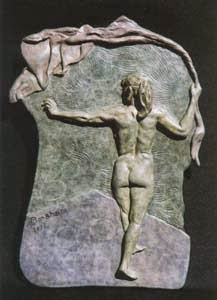
"Oh Boy!"  [Mirror of Men, what a fun way to brush one’s teeth in the morning!], "Rehearsal" (the woman waving the large fabric over her head), and "Infinity" (created for the eighth wedding anniversary gift of bronze material, note the figure eight as the outside shape).


I have been thinking of new compositions to create in bas-relief because I think the story-telling ability is very similar to painting in that respect.  But I hope you enjoy the compositions that I have created thus far.

[Ask, please, about availability, or commission some art for yourself or another.]


Thank you for your interest and enthusiasm,
Kelly
~ Kelly Borsheim, sculptor, painter, writer, teacher
http://BorsheimArts.com

Infinity bronze bas-relief sculpture by Kelly Borsheim
"Infinity" bronze bas-relief sculpture by Kelly Borsheim

Saturday, March 30, 2013

Little Jerusalem Pitigliano Italy


Cari Amici (Dear Friends),

I found myself exploring the town of Pitigliano, Italy, recently thanks to my friend Caroline. Pitigliano lies south and east of the more famous Grosseto and is very close to the southern Tuscan border. Pitigliano has a history dating back to the Etruscan times, but in 1293 the Orsini family gained control and began its history warring with Siena.

The city emerges above the tufa rock, rising from organic to geometrical forms, with caves visible in which I was told that hermits used to occupy. Those spaces closer to the paved road that leads into the city were once used to keep donkeys. Now they are simply storage rooms.

I thought it was funny that the map of this city perched on an elongated peak looks a bit like a slug from above, since my traveling companion and tour guide described this city as beautiful, but a bit claustrophobic. She said she could not life there because of the closeness of everything, namely the narrow streets. I knew that I wanted to come back to explore this place longer than the two hours or so that we had there.

While there are few if any Jewish people living in Pitigliano today, it was historically a town quite friendly to the Jewish population. My friend Caroline and I visited the former ghetto in the historic district, now a small museum. We learned that in 1556, a Jewish cemetery was created by the nobleman Niccolò Orsini IV, who had always been supportive of the Jewish population in his territory. He gave the land for this purpose to his personal physician, David de Pomis, a Jew. You may see this cemetery in the last image of this post, below the cypress trees on the left and above the bridge of arches.

The Ghetto was officially begun in 1622 by the ruling Medici family. In the 1800s one-fourth of the population of Pitigliano was Jewish and the community became known as “Little Jerusalem” (a name given by the Jews in Livorno, a city to the north). The brochure says that after the Unification of Italy in 1861 and the emancipation of the Jews, many Jewish people left Pitigliano for larger cities. It is also reported that the remaining Jews were helped out of the city by their supportive neighbors as the racial laws and dangers of World War II came about. Today the city is reported to have so few Jews that they cannot gather enough for a minyan, the minimum number of ten adults required for specific religious gatherings.

The thick stone walls of “Little Jerusalem” give one the impression of being in a cave. In truth, the Jewish people simply adapted the existing spaces when they settled in this part of Pitigliano. And people for centuries have understood the value of going underground for consistently cooler temperatures to store wine and other goods. A couple of the upper rooms near the entrance housed Jewish items, many of which I found quite beautiful, such as this woven Havdalla Candle for use on a Saturday evening. I also found the scroll and the Hebrew writing lovely.

The image of the room with the black bars in front of it is the butcher’s area. It was here that animals were slaughtered in accordance with the Jewish laws. After death, the blood is drained from the animals so that the people will not consume it since “blood is life.” [I do not quite understand this idea (do we not eat to live?), but then it may be that the brochure has simplified a lot and I did not intend to do an in-depth study of cultural rites, however interesting.]

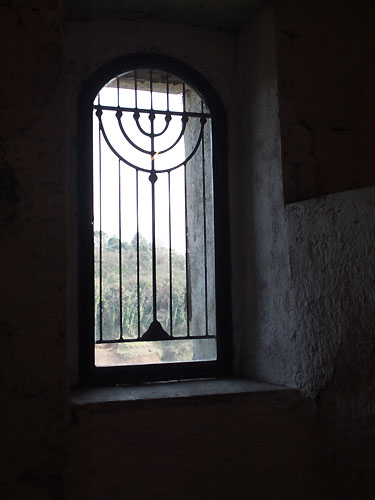
The Synagogue of Pitigliano was built in 1598, but collapsed gradually in the 1960s. It was restored in 1995 and contains furnishings from the 17th and 18th centuries. One cannot enter the prayer room; however we followed the stairs to a balcony. A beautiful wooden rail in a lace-like pattern protected us from falling. It was quite high, but I did manage to stick my arm out above the top rail to show you the downstairs, as well as the ceiling.

You might wonder why I am writing about ruins and such when this blog is usually about art. In my mind, everything is connected. And as my late friend Vasily Fedorouk liked to say, “The artist is the best kind of scientist because he studies everything.” I think the word “best” is something lost in translation for my Ukrainian-born friend, but I think you can grasp his sentiment for artists.

Sunday, January 13, 2013

Painting the Female Figure Magda


Cari Amici (Dear Friends),

Back in October, I wrote in a blog post about my oil painting of Magda. And I shared with you some of the process of the painting I was creating as a study of a nude woman’s back. Here is the finished work.

”Study of Magda”
80 x 40 cm
Oil on Canvas
By Kelly Borsheim 2012
Available, just ask…

Also, a gentle reminder that if you enjoy the art of sculpture and are intrigued by the vision and work of my friend and artist Vasily Fedorouk, please see this once-in-a-lifetime offer to receive more art with his sculpture in this special offer in my latest art newsletter: http://www.borsheimarts.com/news/2013_01_GuggenheimSerraBilbao.htm

Thursday, November 22, 2012

Olive Harvest IV Tuscany Italy Thanksgiving


Cari Amici (Dear Friends),

Today is the American holiday of giving thanks. There are enough ex-pats here in Firenze, Italia, that tonight will be my second American-style holiday meal. It kills me. I have a love-hate relationship with Thanksgiving. Of course, I enjoy the family and friends getting together part. I have had great holidays, and so-so holidays. (‘So-so’ usually means alone. As much as I enjoy being by myself, the holidays are not the best time to be scheduling that.) But the part I really have never adapted to is that no matter how much self-control I try to exhibit, I always end up eating far more than makes me feel good.

I have been sharing with you on recent posts my excursion into the countryside of Tuscany for the annual olive harvest. It was a glorious weekend that I am never likely to forget. I enjoy being outside most of the time and I must be around trees in order to keep my sanity. Some people think that is weird, but I think that NEEDING to have coffee every day is weird. To each their own . . .

But seriously, while picking olives, Viola invited us to stay for dinner with the family and other friends who were helping pick olives from the trees in Renato and Giuliana’s field. We were a decent-sized group and I never cease to be amazed when people prepare food, especially for a lot of people at once. “Volentieri” I replied! They had new oil, lots of vegetables to dunk into the oil, and then the courses began. . . oh, my. And it seemed that each new dish was more fun than the previous.

The wine flowed and the conversation at the table was lively and fun. Roberto was charmed when 10-year-old Marco asked his 90-year-old grandfather Renato where he had put his teeth and Renato said, “I keep them in the bedroom!” I am still learning Italian and also some of the slang and dialects. It was lovely to have an Italian friend with me who speaks English quite well. I missed fewer jokes that evening.

By the time the calcio (soccer) game came on the tele, we were pretty tipsy. [It was a good game to watch and the Florentine team won. I admit that I did enjoy it, especially the cheering and hugging at the table. Forza Viola! Purple is the color for the Florentine team.] However, after dinner came dessert, including the sweet liquor Vin Santo with biscotti and chocolate. Grappa followed, but this time I refrained. I was enjoying my buzz as it wuzz, thank you very much.

After helping Giuliana and Daniela wash and dry the dishes near a warm fireplace in the kitchen, I saw that Giuliana had passed around her copy of my book, “My Life as a Street Painter in Florence, Italy” for friends to see. That would never have occurred to me to do and I was touched that she thought of it. [This book makes a great gift, and, if interested, click on the title and you may order it from Amazon in several different countries.]

Today, I am sending you the last of the series of my wonderful weekend with the olive trees and the locals. We picked and gathered the olives and then loaded the cassettes into the tiny truck. The olives were moved to a shelter near the house and for good reason: It rained the next day. One cannot pick wet olives because they will start to mold before you could press them. Next time I go back, Renato said they would show me where the pressing happens, if the harvest has been completed that is. I will be returning soon… If you are hungry for more images, check out my photo album “Italian Scenics” on Facebook. Thank you so much for joining my journey and for your support and interest in my art work and the work of my maestro and friend Vasily Fedorouk.

Happy Thanksgiving.