Showing posts with label Tuscan. Show all posts

Saturday, March 30, 2013

Little Jerusalem Pitigliano Italy


Cari Amici (Dear Friends),

I found myself exploring the town of Pitigliano, Italy, recently thanks to my friend Caroline. Pitigliano lies south and east of the more famous Grosseto and is very close to the southern Tuscan border. Pitigliano has a history dating back to the Etruscan times, but in 1293 the Orsini family gained control and began its history warring with Siena.

The city emerges above the tufa rock, rising from organic to geometrical forms, with caves visible in which I was told that hermits used to occupy. Those spaces closer to the paved road that leads into the city were once used to keep donkeys. Now they are simply storage rooms.

I thought it was funny that the map of this city perched on an elongated peak looks a bit like a slug from above, since my traveling companion and tour guide described this city as beautiful, but a bit claustrophobic. She said she could not life there because of the closeness of everything, namely the narrow streets. I knew that I wanted to come back to explore this place longer than the two hours or so that we had there.

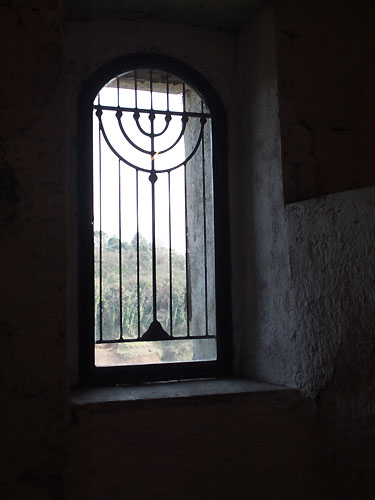
While there are few if any Jewish people living in Pitigliano today, it was historically a town quite friendly to the Jewish population. My friend Caroline and I visited the former ghetto in the historic district, now a small museum. We learned that in 1556, a Jewish cemetery was created by the nobleman Niccolò Orsini IV, who had always been supportive of the Jewish population in his territory. He gave the land for this purpose to his personal physician, David de Pomis, a Jew. You may see this cemetery in the last image of this post, below the cypress trees on the left and above the bridge of arches.

The Ghetto was officially begun in 1622 by the ruling Medici family. In the 1800s one-fourth of the population of Pitigliano was Jewish and the community became known as “Little Jerusalem” (a name given by the Jews in Livorno, a city to the north). The brochure says that after the Unification of Italy in 1861 and the emancipation of the Jews, many Jewish people left Pitigliano for larger cities. It is also reported that the remaining Jews were helped out of the city by their supportive neighbors as the racial laws and dangers of World War II came about. Today the city is reported to have so few Jews that they cannot gather enough for a minyan, the minimum number of ten adults required for specific religious gatherings.

The thick stone walls of “Little Jerusalem” give one the impression of being in a cave. In truth, the Jewish people simply adapted the existing spaces when they settled in this part of Pitigliano. And people for centuries have understood the value of going underground for consistently cooler temperatures to store wine and other goods. A couple of the upper rooms near the entrance housed Jewish items, many of which I found quite beautiful, such as this woven Havdalla Candle for use on a Saturday evening. I also found the scroll and the Hebrew writing lovely.

The image of the room with the black bars in front of it is the butcher’s area. It was here that animals were slaughtered in accordance with the Jewish laws. After death, the blood is drained from the animals so that the people will not consume it since “blood is life.” [I do not quite understand this idea (do we not eat to live?), but then it may be that the brochure has simplified a lot and I did not intend to do an in-depth study of cultural rites, however interesting.]

The Synagogue of Pitigliano was built in 1598, but collapsed gradually in the 1960s. It was restored in 1995 and contains furnishings from the 17th and 18th centuries. One cannot enter the prayer room; however we followed the stairs to a balcony. A beautiful wooden rail in a lace-like pattern protected us from falling. It was quite high, but I did manage to stick my arm out above the top rail to show you the downstairs, as well as the ceiling.

You might wonder why I am writing about ruins and such when this blog is usually about art. In my mind, everything is connected. And as my late friend Vasily Fedorouk liked to say, “The artist is the best kind of scientist because he studies everything.” I think the word “best” is something lost in translation for my Ukrainian-born friend, but I think you can grasp his sentiment for artists.

Saturday, December 25, 2010

Officina Ristorante Colle Di Val D’Elsa Italy

Cari Amici (Dear Friends),

Whether you use it or not, social media, such as Facebook, connects people, and sometimes in wonderful and otherwise unlikely ways. It was through Facebook and our common love of Florence, Italy, that the Diva of Divina Cucina, Judy Witts Francini, and I met. I am not sure if I have met anyone as intensely interested in most everything as Judy is. It is no wonder that people from all over the world come to take her cooking classes and her tours of Tuscany.

While I was still in Italy this past summer, Judy introduced me to the Officina della Cucina Popolare restaurant in a little town called Colle di Val d’Elsa, not far from her home in Certaldo. The drive from Florence was lovely. If you would like to see some of my snapshots along the route, visit my Facebook album about the Italian countryside.


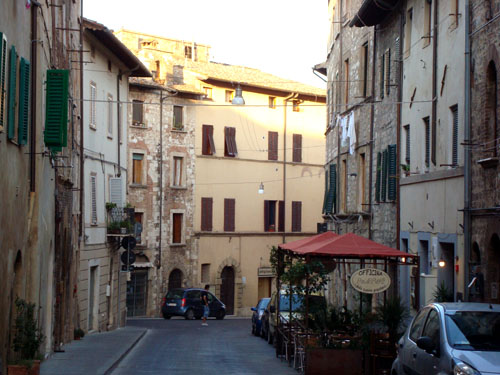
I would have preferred to eat lunch there so that there was time to explore the medieval town, but my schedule would not allow it. Colle di Val d’Elsa is known for its lead-glass products and appears to be one long stretch of a town, running along the spine of a hill. The light on the long days here was starting to fade and I tried to get off a few images before the sun was completely gone. We parked (for free) outside of a very castle-like looking entrance all the “Porta Nova.” Not far inside is L’Officina on the right.

We sat outside to enjoy the evening air. The restaurant is very simple and therefore not overly “Italian” as more touristy places can be sometimes. The place had few visitors when we arrived on a Friday night just as they opened, but Italians eat later and the place was completely full before half-way through our dinner. The food was creatively prepared, beautifully displayed and a wonderful sensation for the taste buds.


The owners prefer a more organic way to live, serving food grown by sustainable local farmers and friends. Their menus are from recycled materials, such as these sides of wine boxes that you see in my photos. Their glasses are cut wine bottles.


I am not difficult to please when it comes to food, generally being happy if anyone but me prepares it. However, in the hands of people with passion for food, I can be completely blown away by the quality of the dining experience! This dinner was superb. I can honestly say that I never felt so … enchanted . . . with a bowl of cheese soup before. Pictured here with the fresh celery for dipping, mmm mmm mmmmmmmm


So, I apologize for not recording exactly what I ate here – sometimes it is difficult to live life and record it at the same time. The meat dish was wonderful and the one image shows Judy demonstrating to me how the traditional Italian cheese gourd-shaped ball is “unraveled” and eaten by locals.


Of the four friends who own and operate the Officina, I met Nicola Zak Bochicchio (isn’t he beautiful?) that evening as he successfully tempted us with the dessert menu. Like me, Judy prefers to order different items and then have all the table guests taste a little of each as they choose. I include three of our choices here. Please note that these are just snapshots with a flash (horrible!) and yet, these desserts still look so yummy (and they WERE)! And to top it all off, the prices were surprisingly affordable.


This last image is one I took that night as we exited through the same Porta Nova. I may not know much about food, but I have a pretty good understanding of the beauty of light. I will be returning to Colle di Val d’Elsa and definitely to the Officina, only for a longer visit next time. I hope you have a chance to experience this kind of traditional Tuscana too.


May the Yule Tide Spirit of Christmas be with you always.