Saturday, September 17, 2016

Harvest Times Valleriana Tuscany


Dear Art Lover,
     Every day I feel grateful and lucky as hell.  The people in my newly adopted home neighborhood are so kind to me and my mind has calmed a lot being surrounded by the Nature of the hills of Tuscany.  Firenze is a lovely city, full of art and interesting situations, but it is still a city.  I am a Nature Girl and I love being home.  The Italians call a village a paese (pie-eh-seh), which means ‘country.’  Context is everything to understanding Italian.  North of the Comune (City) of Pescia in Tuscany is a scattered group of ten paese.  They are collectively called Valleriana.

Sunflowers in Valleriana, Tuscany, Italy

il paese in Valleriana Tuscany Italy with growing beans of Sorana
One paese in Valleriana Tuscany Italy with growing beans of Sorana
     I am sad that summer is coming to an end, but then, it seems that everything eventually does; even if not really.  Life is a sine wave, but the time is flying by!  I include some images from walking distance around my home.  I am extremely lucky that my landlord repeatedly offers me anything I want in his campo (field/farm).   Almost everything in these hills is terraced land. 

     In Italy, each region has its crop or products that are famous, at least in the rest of the country [meaning Italy].  Besides having many varieties of a tomato, for example, each region of Italia has a unique environment.  This lends a special sapore (flavor) to produce grown in one region over another.  The Italians are quite sensitive on taste.  Before I came to bella Italia, I did not know that one should not put a tomato in the refrigerator, as it loses flavor there.  I did not pay attention as much to the specific flavor of a tomato.  Oh, that is not entirely true:  I remember now that the Mexican Roma tomatoes were my favorite when I lived in Texas.  The second favorite is cherry tomatoes because one can pop ‘em inside the mouth for an internal explosion experience!  But, I am certainly learning to distinguish more now!

     Valleriana has many products and fresh foods grown here [including pomodori (tomatoes), but the most well-known might be the white beans of Sorana.  That harvest of beans that I helped with will be featured in the next post.  These images today were taken around the end of August/early September. 

     I still do not have a car, although it is getting a driver’s license here that is the hold-up.  The laws have changed on this as well and it is now very difficult and very expensive to receive a driver’s license here.  No more transferring a valid American driver’s license for an Italian one.  I heard that is because with the immigrant situation here, many people are arriving in Italy without the ability to drive or even to read.  Some have drinking habits and drive while drunk.  Italy has made it more difficult to get the license to try to stop irresponsible or unqualified drivers to be on the roads.  I find this ironic since Italy has also been famous for its crazy (Italian) drivers!  And up on the sidewalk we go! Haha. 

     So, the image of the truck is one way that I am able to buy food that I do not receive from my landlord’s gardens.  Once a week, these brothers drive their van around Valleriana.  Mostly they sell veggies and fruits, but they also have some sausages, GOOD parmigiano cheeses, and some food produces in glass jars, such as artichoke hearts.  They stop not far from my home, but I must catch them since deliver time varies depending on how many customers in any given season.

      Enjoy and go natural!
Peace,
Kelly


Sunflowers grown beneath the local church tower Valleriana Italy

Faggioli di Sorana; growing beans in Valleriana Tuscany


Happy Christmas Trees grow in my favorite patch of Tree Farm Valleriana Tuscany
Happy Christmas trees grow in my favorite patch of tree farm Valleriana
Brothers deliver fresh produce for sale in the hills of Valleriana
Sorana beans netted for protection against animals Valleriana hills of Tuscany
Sorana beans netted for protection against animals; Terraced hills of Tuscany
Fig trees with ready fruit in Tuscany Valleriana
Fig trees - man, do I eat well here!
Olives growing for hopeful harvest in November Valleriana
Olives growing for hopeful harvest in November in Valleriana
Lavender harvest Stone carving sand bags
Lavender; back: making sandbags for stone carving
Sorana beans co-habit terraced land with olive trees Valleriana Italy
Sorana beans co-habit terraced land with olive trees
Grape harvest in Tuscany
Never forget the grapes!


Wednesday, August 24, 2016

Ironworks Suspended Bridge, Tuscany


Ironworks Suspended Bridge, near Abetone, ItalyDear Art Lover,

     A couple of our friends and colleagues from the recent Tuscan symposium also had participated in a symposium for wood carving in the forest near Abetone, Italy (famous for skiing in the winter, blueberry festival in August).  So, quarry owner Marco Nardini took Kumiko Suzuki and me to this forest in Pian di Novello, slightly southwest of Abetone.

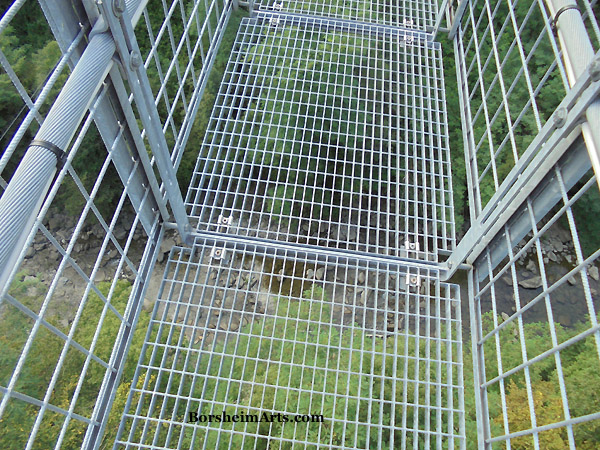
     As we wound through the curvy roads through the mountains, Marco asked us if we were afraid of heights.  We said we were game for what he had in mind and thus before we arrived to the symposium site, we found ourselves walking across the “ponte sospeso” (Suspended Bridge) in Comune di San Marcello Pistoiese.

     According to a sign on the site once one crosses the bridge, the longest suspension on a bridge is 1991 meters for the Akashi Kaikyo Bridge in Japan.  It has intermediate supports that span as much as 282 meters!  

     Marco told us that when he was a kid, this footbridge we were on (called the Ironworks Suspension Bridge) was rope and wood slats, with some of those missing.  It was more terrifyingly exciting than it is today, although, of course, much more dangerous and swinging movement.  The original bridge was only intended to be around for a few years.  It was built to aid workers from Popiglio get to the metallurgical plant of Mammiamo Basso quicker, shaving several kilometers [one way] off of their daily trip across the river.

Ironworks Suspended Bridge, near Abetone, Italy
This sign is in front of a small, unassuming park that contains the entrance to the bridge

     The work was started in 1920, and S.M.L. ordered the plant closed in 1931 to focus manufacturing in Campotizzoro.  However, the bridge was so admired by all, and the designer Vincenzo Douglas-Scotti (1877-1937) praised, that the bridge not only remained, but was recreated in the materials one sees today. In 1980 it was reworked and again improved in 2004.  In 2014, solar-powered LED lights were added, making the bridge more beautiful. 

A quote from one of the signs there:
“The Area of the Suspension Bridge

     Since prehistoric times, the valley of the Lima torrent, the greatest tributary of the Serchio River, represented a route for penetrating and crossing the Apennines by nomad hunters and later Roman armies or medieval travelers.  The flat areas, now dominated by the suspension bridge, offered an ideal place for resting or camping, which is evidenced by the recent archaeological finds of worked flints dating back to the Epigravettian period (late epipaleolithic – about 9/10,000 years before Christ and ceramic fragments from the Roman Age, which are now preserved in the Naturalistic Archaeological Centre of the Pistoia Apennine, based in Campotizzoro and the Civic Museum of Natural Sciences and Archaeology of Val di Nievole.

     At that time the Lima torrent, like the Limestre torrent and the other main tributaries offered ideal conditions for setting up numerous hydraulic plants.  Think of the mills built to transform chestnuts into sweet flour, the main local foodstuff, and the pioneering Cini paper mills and many ironworks.

     The Magona Granducale, a Tuscan company regulated by a monopolistic regime for the production of iron in 1704, started with building the plants of Mammiano Basso, which soon became the largest production center in the area of Pistoia.

     When Magona was abolished in 1836, the production of iron and steel in Mammiano continued despite the subsequent numerous transfers of the structures, which finally ended up at the S.M.I. (Italian Metallurgical Company) at the end of the nineteenth century.

     It was during this period that the engineer Vicenzo Douglas-Scotti, who designed the bridge, was called upon to manage the plant.  Today, the area continues to be of great interest for its hydroelectric production, which is also implemented by using part of the canalizations and pipes that were originally created for the Magona plants.”

The Ironworks Suspension Bridge is free to walk across and admire the views.

Peace,
Kelly


P.S.  I woke this morning to an e-mail from my father asking if I was safe from the earthquake.  I was unaware of another one in Italy.  It occurred during the night last night and it looks devastating.  It was south of Tuscany, but tremendous.  As I write this, rescue workers are still searching to save anyone under the rubbish that they can. 

Ironworks Suspended Bridge, near Abetone, Italy

Ironworks Suspended Bridge, near Abetone, Italy

Ironworks Suspended Bridge, near Abetone, Italy
Marco and Kumiko enjoy the Ironworks Suspended Bridge

Ironworks Suspended Bridge, near Abetone, Italy

Ironworks Suspended Bridge, near Abetone, Italy

Ironworks Suspended Bridge, near Abetone, Italy

Ironworks Suspended Bridge, near Abetone, Italy

Ironworks Suspended Bridge, near Abetone, Italy

Ironworks Suspended Bridge, near Abetone, Italy metalwork, screws

Ironworks Suspended Bridge, near Abetone, Italy

Sunday, August 14, 2016

Stone Carving Symposium, Vellano, Tuscany


Kelly Borsheim stone carving symposium Vellano Tuscany Italy Pinocchio
First day symposium:  4 July 2016
Dear Art Lover,

     Enough friends have asked me about the status of my sculpture “Pinocchio sul Columbo” [“Pinocchio rides on the Dove” that I stared on 4 July for the stone carving symposium at Cava Nardini in Vellano, Tuscany, Italy.  After two cracks in the stone called pietra serena [a grey sandstone] made me scrap my original idea, I overdesigned the next idea.  Normally, one finishes the work DURING the symposium, but I knew that this was a very laid back situation and that it is local for me.  In fact, all of the participating sculptors were fairly local.  Several of us stayed longer to finish our compositions. 

     I still have 2-4 days of work left to do to make a presentable piece.  However, tomorrow is Ferragosto, a national (Catholic) holiday in Italy.  I also still do not have a car and depend on Marco Nardini, quarry owner and really nice guy, to pick me up and take me home, so the schedule is at his convenience, as far as I am concerned.

Anyway, without further ado.  The first image is me standing next to the stone chosen and set up for me before the symposium started.  Because of my leg injury and my bronze fountain sculpture commission, I was not able to go to the quarry beforehand to select my stone, so I sent approximate dimensions for my original idea to Silvio Viola, a sculptor and the organizer of this event.  The symposium started on 4 July 2016.

It is really great working at a quarry.  If we needed tools or the stone moved or a hole drilled, it was far easier to do in on a regular work site than have to make special arrangements to have these things done in a timely manner.  This was the first time that I had assistance on my sculpture.  I would cut, or more accurately score, the stone where I wanted some removed.  Another artisan would come to chip away what I had scored.  I do not know if I did my knee more or less harm during this event, but hey, I am sculpting stone again!

Kelly Borsheim stone carving symposium Vellano Tuscany Italy Pinocchio
10 days later... 14 July 2016 "Pinocchio sul Colombo"[unfinished]

This second image was taken on the last day of the symposium, July 14, 2016.  It is clearly not finished.  Many people still do not see the idea.  Or as Kumiko quipped, “It looks like a mosquito attacking a bird.”  Thankfully, the two of us have returned enough days that the form is coming together as much as possible, considering the cracks that stopped me from making a more romantic composition.  [Had I brought the wing tips together, the front view would have had more “ohh la la” as the wings formed a flame shape.  Boh!]

I will post the after shots once I have finished the work, probably in my next art newsletter.  Subscribe if interested.  http://borsheimarts.com/contact.htm

Thank you.  Buon Ferragosto, Italia!

Peace,
Kelly


Kelly Borsheim stone carving symposium Vellano Tuscany Italy Pinocchio