Saturday, March 12, 2011

Stone Carving Pelican Lips

Cari Amici (Dear Friends),

Each day that I work to carve out the interior forms of my marble “Gymnast” I wonder if I am insane to have chosen to do this. However, the more the air enters the stone carving, the more I see that I made the right decision. It is slow going, and I can only appreciate that I have electric tools to speed it up a little. The difficulty has been in REACHING those inside areas.

While I work, my mind drifts onto thoughts of lips. I need to carve more on the “Gymnast”’s face, but I want to wait until the interior is more defined and I can focus on the face.

So, I will share with you part of my lips series in stone sculpture: “Pelican Lips” His dimensions are 12.5" h x 22" w x 6.5" d.

The stone is a brown marble from Canada, but the patterns in the stone look a lot like petrified wood. At the time that I carved this one, I had been seeing a lot of bird forms around me. I have watched pelicans (and their funny suicidal-looking hunting dives, straight down and head first into the water) along various coastlines throughout parts of my life. One side of the thick slab of stone in this sculpture shows a pair of human lips, while the other features a pair of pelicans. Bringing nature to humanity ;-)


If you enjoy this artwork and are interesting in purchasing him, please contact Don Elliott at the Franklin Barry Gallery / The Frame Shop
617 Massachusetts Avenue
Indianapolis, Indiana 46204
Tel. 317.822.8455
E-mail: theframeshopindy@aol.com

Layaway is accepted, too! Thank you for your interest in stone carving!


P.S. In this last image, you may see how, as a direct carver, I am drawing directly onto the stone. The stone tends to pale in color during the carving process, but once he is polished his true glory appears!

Monday, March 7, 2011

Awe in Stone Carving

Cari Amici (Dear Friends),

“How did you do that?” is one question that seems to define the word “awe” for me. That is the one of the reasons I cannot seem to make a simple design in my sculpture – the attempt to make you (and me) feel awe. But I know that I also do it for the light. Mainly here, I am speaking about undercuts. I get frustrated enough because I am a slow producer, but then in the course of doing the work, I always seem to want to push myself to tackle a new challenge.

So, in my current marble carving project, the “Gymnast”, I thought creating a face that I can hardly reach was bad enough. Today, I took a masonry bit and drilled through the stone to create a space between the upper body and the vertical thighs. The “Gymnast” is in a tight pike position, with her toes pointed to the heavens.

I cannot tell you how wonderful it feels to drill from one end of the stone to the other and have the drill bit emerge on the other side … in the intended position! Twice even – once over the breasts but under the arms and the second hole was created below the breast line. This seems like a no-brainer, but sometimes it is easier to measure the angle of the drill when one is not right on top of it. It is helpful to have someone else around on occasion to act as an extra eye or hand, but it did not happen today and I wanted to get on with it.


After I created the first two holes, I then changed to one of my new favorite tools – a double cut carbide tip on a 6” shaft. As seen here in the photos, I used it to go in from the top between the arms to start to connect holes and open up the space a little bit. I tend to stand back from the piece often to check my proportions and line. At some point, I drew in a line for the bird’s eye view of the breasts, keeping the line further out than I really want to cut. I can refine the line later, but I will never be able to retrieve cut stone.


In this last image, I am looking over the left shoulder of the “Gymnast” and down into the small opening of her folded up form. Really, what was I thinking?

My goal was to finish this marble sculpture before I returned to Italy in May, but I would be surprised if I can pull that off. Still, it is good to have goals.


Saturday, March 5, 2011

Sculpture Challenge Texas

Cari Amici (Dear Friends),

Oh boy, did I screw up! I meant to write this post two days ago… you ARE invited!

Saturday, March 5, 2011: Sculpture Challenge (Texas) fundraiser for PAWS Animal Shelter


Hours: 10 am to 5:30 p.m.

Over a baker’s dozen of sculptors with even more art will be on hand for this event out in the sculpture gardens and grounds of my friends Philip and Michelle Hoggatt. They are two of the kindest, most generous people you could ever meet and they host this annual event for a local charity.

Plus I will be introducing my newest marble carving “Back to Back” – yep, the one that you have watched getting carved here on occasional blog posts. This marble sculpture will be entered into the Sculpture Challenge. Each artist is allowed to enter one piece and those attending the event get to vote on their favored works. It is a friendly competition, but the real goal is to help find homes for puppies of any age and needed funds for the shelter.

I will also have a few selected smaller works on exhibit and am just happy to be forced from a semi-seclusion. Do not get me wrong – I love to be alone and it is necessary for my process, but everyone needs a balance. It will be fun to connect with old friends and meet some new people.

Please come on out if you can (and if you have not received this too late):

CARVED STONE, INC.
5300 Bell Springs Rd. Dripping Springs, Texas 78620
Contact: Philip & Michelle Hoggatt Phone: 512-858-5665
Admission requires a $10 per person donation to PAWS. All ticket proceeds benefit PAWS. Also, if you purchase one of the sculptures entered into the Sculpture Challenge, 20% will go to PAWS.

Tuesday, March 1, 2011

Notan Art Design

Cari Amici (Dear Friends),

I keep thinking about art design, specifically creating an emotional feeling with just two tones. You have heard me talk about Notan before – a Japanese design concept that uses just black and white to create a composition.

I wanted to illustrate this idea using a painting by the British landscape artist JMW Turner (23 April 1775 - 19 December 1851).

Due to a lack of time, I worked backwards and took a black and white image of Turner’s painting into Photoshop. I then greatly increased the contrast and a little bit the brightness until I had a decent pattern of mostly white and black.

Now, do not cheat and read to the end, but instead look at this image and take note of any feelings that come to mind when you look at this arrangement of black and white shapes.


As I argued in my recent newsletter, I do not see the above image as art. I see it as a concept expressed graphically, but it needs more to really communicate the idea successfully. We visual artists have a visual language and can try to make you feel something using our alphabet that consists of lines, tones, shapes/form, texture, and color. If Turner were a writer, this would be his rough draft, or perhaps the equivalent of an idea scribbled down onto a napkin at a café. More work needs to be done for the viewer to understand what the author wishes to share.

This second image is a black and white version of the painting by JMW Turner. For me, the idea has been well developed here – enough for me to understand the power in the swirling shapes.


Finally, I give you the final painting in color. The idea has been fully expressed. I hope that this image stirs something inside you. I also hope that you can see a huge difference in the basic design vs. the finished artwork. Can you guess the title?


This painting is titled “Snowstorm” and was painted in oil on canvas by JMW Turner in 1842. This beaut is approximately 92 x 122 cm. If you would like to see more of Turner’s paintings, as well as a comparison to the canvases of Mark Rothko, please click here for my newsletter on the topic of “Art vs. Science” I also wrote about the color yellow in art . . . enjoy and thank you for your continued interest in this blog.

Wednesday, February 23, 2011

Artist Collecting Art


Collecting Art

Cari Amici (Dear Friends),

Canadian painter and one of the art world’s mentors and avid supporters Robert Genn recently wrote on the topic of laughter in art. I had to laugh … in recognition.

You see, part of the reason that I went to visit my friend Dilya in Chicago was to pick up the sculpture I had been making payments on for a while. I bought one of her late husband Vasily Fedorouk’s ceramic sculptures that you see here.

Dilya was surprised by my choice, thinking that I would want one of Vasily’s stone works. And I do… trust me… I do. I have several of his stone carvings on my wish list, but I explained to her that right now, even with payment plans, I was not just able to afford a work in stone. Also, I have fond memories of this particular work in ceramic. Many years ago, some members of my family and I were visiting Vasily (Dilya was in New York at the time) and we had quite a fun afternoon, including us laughing together about several of Vasily’s more erotic artworks. Fun and playful. And absolutely art. Naturally, I have photos of us all goofing around in Vasily’s home gallery, but I am not ready to unleash those upon the world.

Anton, son and sometimes model for his artist father, took this image of Dilya and me with my new sculpture. [Airport security personnel and I had some good laughs over this piece as well after I was pulled aside for a more thorough check.]


I tend to purchase art that gives me an emotional feel, even at times when it was one that I was not expecting. Another such surprise was Jane Dedecker’s bronze sculpture “Swinging” depicting a child flying at the end of his mother’s arms. Like Norman Rockwell, Jane Dedecker’s family-oriented compositions manage to avoid kitsch and instead seem only charmingly nostalgic. I like her looser style, which means the smaller works. And I love the energy of the sculpture I bought.

The funny thing about me is that many of the artworks (paintings and sculptures) that I have collected were purchased when my bank account was almost empty. When I bought one of my friend Marc Silva’s paintings from his “In-SPIRE-ed” series, I asked the gallery owner if he would “wait to charge my card until after the 14th of the month to save me a month’s finance charge.” The exhibit would not be over by that date anyway. I somehow manage to pay everything off. I have never regretted any of those purchases because I look around my studio and home and I love the works that surround me. And love really is what it is all about, right?


Saturday, February 19, 2011

Ukrainian Sculptor Gregor Kruk

Cari Amici (Dear Friends),

The current exhibition at The Ukrainian Institute of Modern Art (UIMA) is of the private collection of the late Bohdan Kowalsky.. The art collections consists of paintings, sculptures, lithographs, wood cuts and drawings by Polish, Ukrainian and Ukrainian-American artists, such as Archipenko, Nowosielski, Gritchenko, Trusz, Hnizdovsky, Solovij, Milonadis, Urban and many others. His collection was bequeathed to UIMA in 2008.

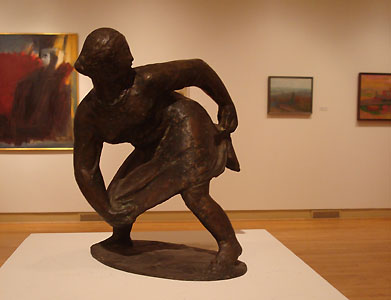
Two of my favorite artworks were bronze figurative sculptures by Gregor Kruk (1911-1988). Although he had a third sculpture there, it was simply a reclining female nude and did not interest me much. However, the two sculptures I show you here were lively and emotional pieces of art and I very much appreciated their honesty and expression.


The first one is “Untitled (Female Figure with Dress)” from around the 1960s. The second “Untitled (Standing Male Figure)” from 1962. I include an image that my friend Dilbarra took of me with the sculpture of Gregor Kruk to give you a better idea of the size of these gems.


According to a page on the site of the Association of Ukrainians in Great Britain:
“After the end of the Second World War Kruk settled in Munich where he composed sculptures in bronze, clay and stone featuring (mainly) figures of peasants, kozaks, working women, bandura players and dancers. Though his works were exhibited in cities across Western Europe and the North American continent, Kruk’s main dream was to have his works displayed in Ukraine.”
There is also a photo of the artist at work at the link above.


Exhibition runs through April 10, 2011.

Here is an interesting article on the life and journey of the collector Bohdan Kowalsky.. I especially found interesting the World War II statistic that of the 11,000 soldiers in a Ukrainian division advancing towards the Russian Army, only 3,000 made it through. Get the details yourself by clicking on the link above.

Happy Birthday to my Uncle George and my cousin Jessica


Friday, February 18, 2011

Ukrainian Artists Bidniak Kholodny

Cari Amici (Dear Friends),

I have written before about the importance of viewing distances in art. Whether it is sculpture or one of those well-designed perspective drawings that you have probably seen via the Internet if not in person on the street (or other “3-d” artworks in a 2-d format), the position of the viewer can make or break the impression the art gives. But even in “normal” paintings, this distance from the artwork changes our perceptions and sometimes emotions when experiencing a work of art.

I have heard it said that gallerists can tell when a visitor is an artist vs. a collector (or perhaps wearing one hat or another because artists can be collectors too!). The collector tends to allow a single or few works grab his attention, paying little heed to the others in the room. The artist examines every single work, most often moving up close to see each stroke.

Today, I am wearing my artist cap (or should I say beret?). Here are two more landscape paintings that I saw at The Ukrainian Institute of Modern Art recently. This first “Untitled” oil on board was painted in 1963 by Ukrainian artist Mykola Bidniak (1930-2000). The detail image (particolare in Italian) appears first.


This second painting is by another Ukrainian artist, Petro Kholodny (1876-1930). His untitled landscape was painted (oil on board) in 1927. Odd that my choice here happened to be of two landscape artists whose lives perhaps never touched, the one dying in the same year that the other was born.


And finally, this last painting has little to do with this post other than I wanted to show it to you. It was also a part of the exhibit (although part of the permanent collection) at The Ukrainian Institute of Modern Art. I looked at “Traffic” up close and later from across the room. It gave me a headache wherever I stood, regardless of viewing angle or distance. However, I had to admit that this 1948 oil painting by Harold Hayden truly captures the agitation and confusion often felt when people start crowding one another. “Traffic” did impress me that I felt this uncomfortable-ness from everywhere in the room whenever I placed my eyes on it.